The Most Sustainable Building Is Often the One That Already Exists
As the United States approaches its 250th anniversary, our history endures not only in monuments and museums but in the buildings that shape our cities. Walk through Old City in Philadelphia or Beacon Hill in Boston and you’ll find structures that predate the country itself yet continue to serve their communities today. These buildings offer more than a window into the past; they point toward a more sustainable future. Buildings account for roughly 40 percent of energy use in the U.S., and an even larger share in dense cities, yet they rarely receive the same public attention as electric vehicles or renewable power in climate discussions.
Nearly 30 years ago, Onion Flats Architecture restored a 200-year-old building in Philadelphia’s Old City. What began as a routine project revealed a lesson that continues to guide our work: sometimes the most sustainable building is the one that already exists. Constructing new buildings demands vast amounts of energy and raw materials, while demolishing existing structures discards carbon already invested. Preserving and upgrading what we have is often the most effective way to reduce environmental impact.
That realization grows more urgent every year. Most buildings that will exist in 2050 are already standing today. The year 2050 has emerged as a widely recognized deadline for achieving net-zero carbon emissions across the global building sector, championed by Architecture 2030 and the World Green Building Council. While new construction will play an important role in this transition, the largest opportunity lies in transforming the buildings that already define our urban fabric.
Cities across the country are beginning to confront this reality. Massachusetts is leading state climate policy, pushing municipalities to address emissions from existing building stock, and deep energy retrofits are emerging as one of the most promising responses. Onion Flats Architecture is currently working on several projects in the Boston area that rebuild the exterior envelopes of older residential buildings, dramatically improving energy performance while preserving the structures themselves. These interventions are integrated with high-efficiency mechanical system upgrades and building electrification strategies, core components of deep energy retrofits (DER) that reduce operational carbon and enable a transition away from fossil fuels.
Much of this work can occur from the exterior, allowing residents to remain in their homes with minimal impact and to avoid the relocation costs that often make large-scale retrofits financially difficult. Lessons from these projects are helping to inform policymakers, building owners, and architects as they translate ambitious climate goals into practical, replicable strategies nationwide.
These efforts reflect a larger turning point. The question is no longer only how we build, but what principles should guide the buildings that will shape the next American century. As the nation marks 250 years, we have an opportunity to define those principles clearly.
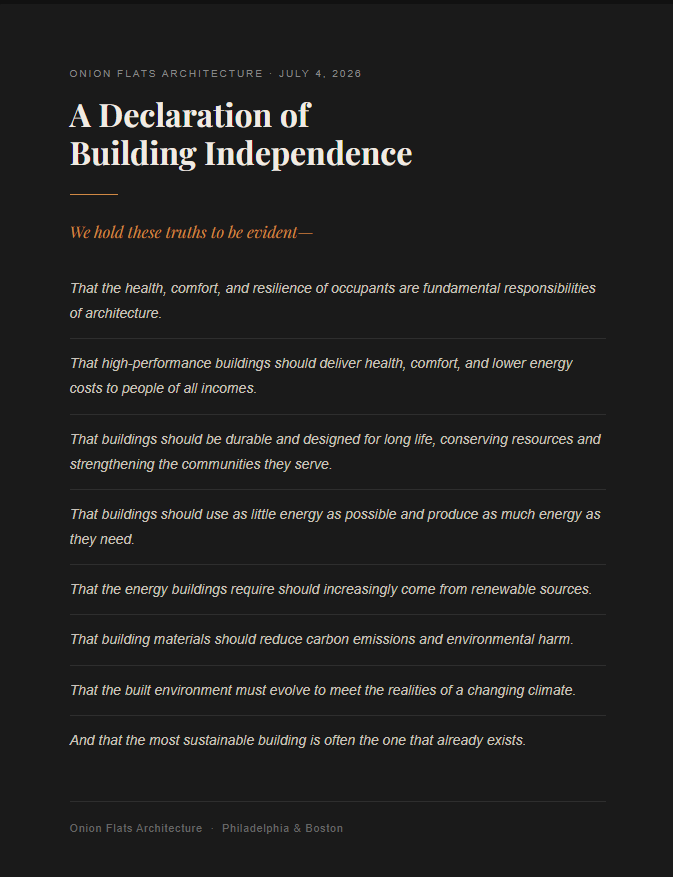
A Declaration of Building Independence
We hold these truths to be evident—
That the health, comfort, and resilience of occupants are fundamental responsibilities of architecture.
That high-performance buildings should deliver health, comfort, and lower energy costs to people of all incomes.
That buildings should be durable and designed for long life, conserving resources and strengthening the communities they serve.
That buildings should use as little energy as possible and produce as much energy as they need.
That the energy buildings require should increasingly come from renewable sources.
That building materials should reduce carbon emissions and environmental harm.
That the built environment must evolve to meet the realities of a changing climate.
And that the most sustainable building is often the one that already exists.
These ideas are not theoretical. High-performance buildings are often assumed to be too expensive for affordable housing, yet projects across the country are proving otherwise.
In 2012, our team completed Belfield Homes, the first certified Passive House development in Pennsylvania. Working with a nonprofit partner, we designed and built three modest rowhouses in Philadelphia for families transitioning out of homelessness. Although no high-performance standard was required, the homes were built to meet the Passive House standard, reducing heating and cooling demand by roughly 80% compared with conventional construction. Prefabricated modular methods shortened the construction schedule and proved that high-performance housing can be delivered affordably and at scale.
What began as a small demonstration project in Philadelphia helped influence housing policy nationwide. Our team engaged housing finance agencies to encourage Low Income Housing Tax Credit (LIHTC) programs to reward Passive House certification targets in their scoring criteria. More than 30 states ultimately adopted this approach in their Qualified Allocation Plans and over time, these policies have helped support thousands of high-performance affordable housing units that deliver dramatically lower energy use while remaining cost competitive. This effort was based on a simple premise: high-performance buildings should be treated as a basic expectation in housing policy, not a special exception.
Experiences like this reveal a simple principle of building design: the cleanest energy is the energy we never need to use.
Congress is now debating the most significant piece of federal housing legislation in more than 50 years, including expansions of the LIHTC program that could finance millions of additional affordable housing units. We need to ensure that the next generation of housing is not only more plentiful, but dramatically more efficient. Architecture alone will not solve the nation’s energy challenge, but it plays a critical role in the transition to a more sustainable and resilient future. They are part of the infrastructure that shapes everyday life, influencing energy demand, housing costs, and resilience during extreme weather.
At a time of global uncertainty and volatile energy markets, reducing energy demand is also a matter of national resilience. Yet federal climate and energy policy has begun to retreat from long-term commitments to clean energy and electrification. In this context, the nation’s buildings become even more important. If the United States is serious about reducing long-term energy vulnerability, the building sector must be part of the strategy. The less energy our buildings require, the less the country depends on uncertain supply chains and unpredictable energy markets. Modernizing building codes, encouraging retrofits, and making high-performance construction the norm rather than the exception would move the country in that direction.
In 1776, the founders declared political independence and set in motion a nation few could have fully imagined. In the years ahead, our buildings must declare a different kind of independence, grounded in efficiency, durability, and stewardship of the resources on which our communities depend.